
By Pauline Cox, Director of Functional Nutrition at Hunter & Gather
Beauty has traditionally been treated as something we work on from the outside. Skincare, haircare, treatments and the things we can see in the mirror.
But from my perspective as a nutritionist, feeling like your best self is much bigger than that.
When I speak to women, one of the things I hear most often is simply, “I just want more energy.” We want to look well, of course, but we also want to feel physically energised, mentally switched on and strong enough for everything we want to do.
Those things are not separate from one another. They are all part of how we experience our health and, ultimately, how much like ourselves we feel.
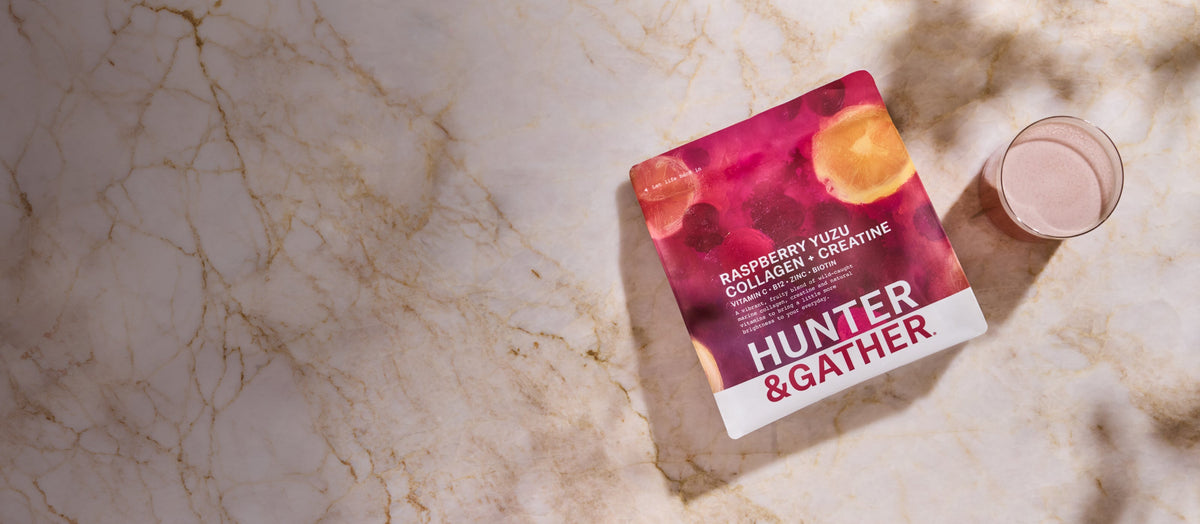
That was the thinking behind Hunter & Gather’s Raspberry & Yuzu Collagen + Creatine.
Most beauty blends focus primarily on what you can see. We wanted to create something that went further: supporting beauty from within, while also considering how you feel on the inside; your energy, your strength and your overall sense of vitality.
That is why the formula brings together 5g of Marine Collagen Peptides and 5g of Creatine Monohydrate, alongside magnesium, vitamin C, zinc, biotin, vitamins B6 and B12, folate and 120mg of Hyaluronic Acid. Each ingredient has its own role, but the point of the formula is how those different roles fit together.
For me, that is what makes an intelligent blend interesting. It is not about adding a long list of fashionable ingredients to a label. It is about understanding what each one is doing there and how, together, they support the bigger picture.

Why combine collagen and creatine?
Collagen and creatine are two of the most widely discussed nutrients in women’s health at the moment, although historically they have tended to sit in very different conversations.
Collagen is usually associated with beauty and structural support. Creatine, meanwhile, has spent years being associated with gyms, bodybuilding and sports performance.
But when I look at them as a nutritionist, I see two ingredients that speak to different parts of the same bigger picture.
Collagen is the most abundant protein in the body and provides important structural support to tissues, including the skin. Creatine is a naturally occurring compound made and stored in the body, where it plays a role in rapid energy turnover and is found in tissues with particularly high energy demands, including muscle and brain cells.
They are not doing the same job, and that is exactly why I think the combination is interesting.
Most of us do not experience our health as a series of separate concerns. We do not wake up thinking about skin in one box, strength in another and energy somewhere else entirely. We want to look well, feel energised, stay strong and have enough of ourselves left for the things that matter to us.
That is the thinking behind bringing collagen and creatine together.
But importantly, this formula was never designed to be simply two popular ingredients put into the same pouch.
Collagen and creatine create the foundation, but the wider blend is what allows the formula to do more. The other nutrients were chosen to connect beauty, energy and everyday strength more deliberately, so that the finished product reflects the way we actually want to feel, not just one outcome in isolation.
And that is where the formulation becomes much more interesting.
Bringing more to the mix: why the wider blend matters
A combination of collagen and creatine gives us a strong starting point, but when I assess a formula, I am always interested in what surrounds the headline ingredients.
That is where an intelligent blend can really come into its own.
For Collagen + Creatine, the question was not simply, “What else can we add?” It was, “What else has a clear reason to be here?”
Vitamin C is a good example.
Vitamin C contributes to normal collagen formation for the normal function of skin. Our bodies do not need collagen and vitamin C to arrive at precisely the same moment, but vitamin C remains an important part of the body’s normal collagen-forming processes. Each serving of Collagen + Creatine provides 80mg of vitamin C, equivalent to 100% of the Nutrient Reference Value.
In my original thinking around the formula, this was important because collagen does not exist in a nutritional vacuum. Busy lives, stress and dietary choices all influence the nutritional foundations we are working with, so I would rather look at the environment around collagen than simply focus on collagen peptides alone.
The same applies to the other nutrients within the blend.
Zinc contributes to the maintenance of normal hair, skin and nails, while biotin contributes to the maintenance of normal hair and skin. There is also 120mg of Hyaluronic Acid in each serving, a naturally occurring substance found within the body, including in the skin, eyes and cartilage.
Then we move beyond beauty.
Magnesium, vitamins B6 and B12, folate and vitamin C all bring different nutritional roles into the formula, including support for normal energy metabolism or the reduction of tiredness and fatigue.
That matters because beauty was never the only objective.
When I speak to women, one of the most common things I hear is simply: “I just want more energy.”
And when we say energy, we rarely mean one thing. We mean the physical energy to move and do the things we enjoy, but also the mental energy to work, think, make decisions and still feel like ourselves at the end of the day.
So while this began as a beauty-led product, the intention was always to create something broader: a blend designed to support how you look, but also how you feel from within.
That is the thread running through the whole formula.
Beauty from within: looking beyond the mirror
When we talk about beauty from within, collagen is usually the ingredient that gets most of the attention.
There is a good reason for that.
Collagen is the most abundant protein in the human body and is an important structural component of the skin. Our natural collagen levels also change as we age, with decline beginning earlier than many people realise and becoming particularly relevant for women as they move through later life stages. Collagen levels begin to decline from relatively early adulthood, with further changes taking place as we age and particularly around menopause.
But I think it is useful to widen the conversation.
Beautiful skin is not created by one nutrient working alone, and good nutrition generally does not work that way either. That is why I am far more interested in the wider nutritional picture than I am in any single “hero” ingredient.
In Collagen + Creatine, each serving contains 5g of Marine Collagen Peptides, providing Type I collagen, the type most abundantly found in skin. Alongside that sits vitamin C, which contributes to normal collagen formation for the normal function of skin.
Zinc and biotin broaden that story further, contributing to the maintenance of normal hair and skin, with zinc also supporting normal nails.
None of those nutrients offers an overnight transformation, and I would be immediately cautious of any beauty product suggesting otherwise.
For me, nutritional beauty is a much longer conversation.
It is about providing the body with the materials it needs, consistently, while also paying attention to the fundamentals that matter just as much: a varied diet, sleep, hydration, movement and the way we look after ourselves more generally.
That is why I prefer the phrase beauty from within.
It moves the conversation away from trying to “fix” something we see in the mirror and towards supporting the nutritional foundations underneath it.
And once we begin thinking in that way, it becomes much easier to understand why energy and strength belong in this conversation too.
Feeling good matters just as much as looking good
The beauty conversation often stops at skin, hair and nails.
For me, that misses a large part of what women actually mean when they say they want to feel well.
Energy is one of the most consistent themes I hear.
And I do not just mean having enough energy to get through a workout. I mean having the mental and physical energy to work, look after a family, go for a walk, see friends, exercise, cook dinner and still feel like yourself at the end of the day.
That starts with good nutritional foundations.
Collagen + Creatine contains magnesium, vitamin B6, vitamin B12, folate and vitamin C, several of which contribute to normal energy-yielding metabolism or the reduction of tiredness and fatigue. Magnesium also contributes to normal muscle function, while zinc contributes to normal cognitive function.
None of those nutrients replaces sleep, time outdoors, movement or a nutrient-dense diet. I would never want a supplement to be positioned that way.
But when the basics are in place, targeted nutrition can sit alongside them.
Good habits rarely exist in isolation. Better sleep, time outside and healthier food choices can all support the way we feel, while better mental and physical energy can make it easier to keep making those choices. One good habit can start a cascade of positive benefits.
That is why I see this formula as part of a wider picture rather than as an isolated solution.
Creatine beyond the gym
Creatine is one of the most researched supplements in the world, but for a long time the conversation around it was remarkably narrow.
Mention creatine and many people still picture bodybuilding, heavy weights and sports performance.
That is beginning to change.
Creatine is a natural compound that the body makes and stores for itself. Its primary role is connected to rapid energy turnover, which is why it is found in tissues with particularly high energy demands, including skeletal muscle and the brain.
What makes this especially interesting to me is how the research around women is developing.
Historically, a great deal of creatine research was conducted in men. We are now seeing greater interest in female physiology and in how creatine metabolism may differ between men and women and across different hormonal life stages.
Women naturally have different creatine stores and patterns of creatine metabolism from men, and hormonal changes across the menstrual cycle, pregnancy, post-partum years, perimenopause and post-menopause may also influence the way creatine is produced and used within the body.
That opens up a much broader area of research than sport alone.
Creatine, brain energy and changing hormones
One of the most interesting emerging areas of creatine research is its relationship with brain energy.
The brain has a high energy demand, and creatine plays an important role in cellular energy metabolism. That has led researchers to look more closely at whether creatine may have relevance beyond muscle, including in areas such as cognition, memory, processing speed, fatigue and mood.
For women, this is particularly interesting because age, hormonal status and life stage can all influence physiology and energy demands. Researchers are increasingly exploring how creatine may interact with these changes across the menstrual cycle, pregnancy, post-partum years, perimenopause and post-menopause.
Another area I find especially interesting is the emerging research around creatine and depressive symptoms. Some studies have reported encouraging findings, particularly in women, which may be linked to creatine’s role in supporting cellular energy within the brain. The evidence is still developing, so creatine should not be viewed as a treatment for depression, but it is a genuinely fascinating area and one I think is worth watching closely.
More broadly, there is growing interest in the relationship between creatine, brain energy, mood, cognitive fatigue and female hormonal changes. We are not yet at a point where broad conclusions should be drawn, but the direction of research is helping to expand the conversation around creatine.
For me, that is the key point.
Creatine is no longer something we should think about only in the context of gym performance. There is a much bigger scientific conversation happening around its role in women’s health, and I think we are only beginning to understand how relevant it may be across different stages of life.
Creatine, muscle and strength through life
The other area I find particularly interesting is musculoskeletal health.
Perimenopause and the years beyond can bring changes in muscle mass and bone mineral density, which makes the fundamentals increasingly important: adequate protein, regular movement and resistance training all matter enormously.
There is also growing research into the role creatine may play alongside these foundations, particularly when it comes to lean muscle mass and wider musculoskeletal health.
Again, supplementation should not replace those foundations.
But I think creatine becomes much more interesting when we stop seeing “strength” as a gym outcome and start seeing it as something that supports the way we live.
Strength is carrying bags home. Getting up from the floor easily. Walking uphill. Keeping up with children or grandchildren. Continuing to exercise, travel and move confidently as we get older.
For adults over 55, there is also an authorised creatine claim: daily creatine consumption can enhance the effect of resistance training on muscle strength when at least 3g of creatine is consumed daily alongside resistance training at least three times per week.
That is a very different story from “creatine makes you bulky”.
And it is a much more useful one.
Who can creatine be relevant for?
Age, sex, health status and life stage can all influence how relevant creatine may be to an individual.
There is no single “creatine woman”.
It may be interesting to someone who exercises regularly and wants to support strength. It may be relevant to a woman beginning to think more seriously about maintaining muscle as she gets older. It may appeal to someone who has encountered the growing research around creatine, cognition and female physiology and wants to understand the ingredient beyond its sporting reputation.
What matters is understanding why you are taking it, rather than adding it to a routine because it happens to be having a moment.
For me, that is the difference between following a trend and building a considered nutritional habit.
A useful product still has to become a habit
There is another part of formulation that often gets overlooked: whether someone will actually take the product consistently.
We can spend a lot of time discussing the research behind a formula, but if it tastes unpleasant, is awkward to use or does not fit into someone’s day, it is unlikely to become a lasting habit.
And consistency matters.
When we create a habit, we remove some of the need for daily decision-making, and our busy, overthinking brains appreciate that. That was one of the points I made in my original article: if you understand the benefit of something and genuinely enjoy taking it, you are much more likely to build a habit that lasts.
That was one of the reasons we made Collagen + Creatine a refreshing Raspberry & Yuzu drink rather than another plain powder.
It can be mixed into cold water, poured over ice, blended into a smoothie or incorporated wherever it naturally fits into your day. The recommended serving is one 15g serving daily, mixed with 300ml of water.
For me, enjoyment is not superficial.
If you genuinely look forward to having something, you are much more likely to keep doing it.
What I look for when I read a supplement label
Before I recommend or take a supplement, there are three things I always look at.
How much of the active ingredient is actually in each serving? Where has it come from? And what independent testing has been carried out?
Those questions matter far more to me than a long ingredients list or an impressive-sounding front-of-pack claim.
That was also central to the way I assessed this formula.
With Collagen + Creatine, the amounts are clearly stated: 5g Marine Collagen Peptides, 5g Creatine Monohydrate and 120mg Hyaluronic Acid per serving, alongside the listed vitamins and minerals.
The marine collagen is responsibly sourced from Norway.
For me, that transparency matters.
As a nutritionist, I want to know what I am actually getting. I think customers should be able to do the same.
Looking well and feeling well should belong in the same conversation
No supplement should replace a varied, nutrient-dense diet, good sleep, regular movement, time outdoors or the fundamentals of looking after yourself.
That was never the intention here.
What interests me about this formula is that it reflects the way women actually think about their wellbeing.
We do not only want healthier-looking skin.
We want enough energy for our days. We want to feel strong. We want to look well, feel well and continue doing the things that make us feel most like ourselves.
That is why I believe a modern beauty blend can, and should, do more than focus on the outside.
Raspberry & Yuzu Collagen + Creatine brings together beauty from within, daily vitality and everyday strength in one considered formula, while still sitting alongside the fundamentals of good nutrition rather than trying to replace them.
For me, that is the more interesting definition of beauty.
Creatine Benefits, Dosage, Safety and Uses: The Complete Science-Backed Guide